
Risk Pattern Analysis
Monitor the risk patterns that recur throughout your trading, and where you stand today.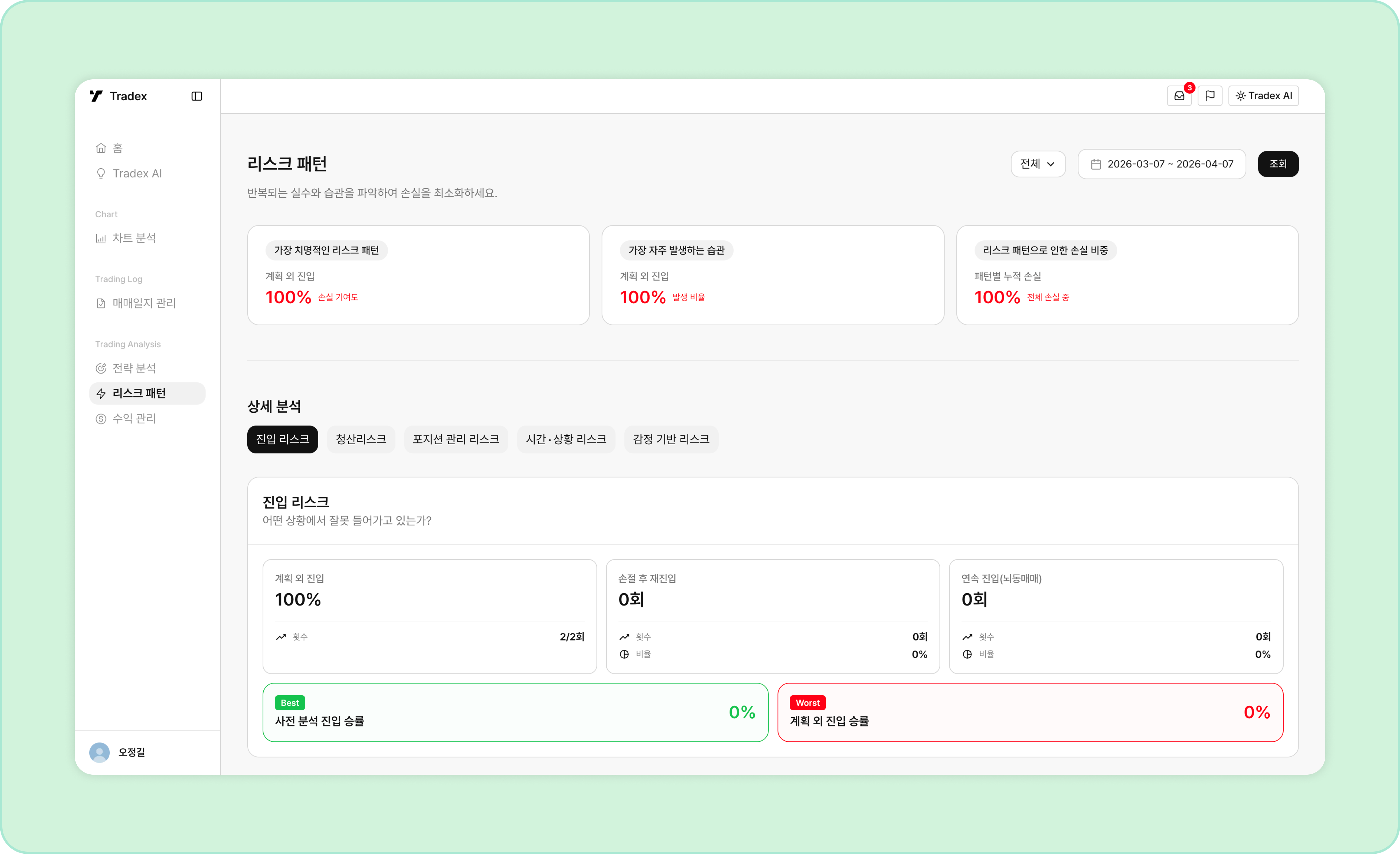
- Most damaging risk pattern: The risk pattern responsible for the largest share of your total losses, with its loss contribution.
- Most frequent habit: The trading habit that appears most often across your trades.
- Detailed analysis: Risk patterns and insight data broken down by detailed conditions.
Detailed Analysis Items
The concept and monitoring conditions of each risk pattern item.1. Entry Risk
- Unplanned entry: You never wrote a pre-trade scenario between opening and closing the trade.
- Immediate re-entry after a stop-out (emotional trading): You took a loss on a position and opened a new position in the same symbol within 15 minutes. (If you wrote a pre-trade scenario, entering within 15 minutes is not counted as emotional trading.)
- Impulsive trading (consecutive entries): You opened a new position in the same symbol within 15 minutes of closing one, three or more times in a row. Adding to the same position three or more times also counts as impulsive trading. (If you pre-set a number of scale-in entries in your scenario, it only counts as impulsive trading when you exceed that number.)
2. Exit Risk
- Stop-loss violation: You closed the final position at a worse price than the SL written in your journal. (Deviations under 0.3% are not counted as violations.)
- Early take-profit: You closed the final position at a worse price than the TP written in your journal. (This only counts as an early take-profit if the market later reached your TP after you closed. If the market never reached your TP, it is not counted.)
- Average stop-loss delay: The average deviation across all trades where the stop-loss was not respected.
3. Position Management Risk
- Average R/R: Average profit divided by average loss.
- Averaging-down frequency: How often you add orders while a position is under water.
4. Time Risk
- Win rate by time of day: The distribution of your win rate by time of day, based on when positions were opened.
5. Emotion Risk
- Emotional trading (immediate re-entry after a stop-out): You took a loss on a position and opened a new position in the same symbol within 15 minutes. (If you wrote a pre-trade scenario, entering within 15 minutes is not counted as emotional trading.)
- Overconfident entry (immediate entry after a win): You took a profit on a position, opened a new position in the same symbol within 15 minutes, and lost.
- Immediate reversal after a stop-out: You took a loss on a position and opened a new position in the same symbol in the opposite direction within 15 minutes.
Risk Score Criteria
Tradex computes risk scores from your trade data.1. Emotional trading
- Basis: The share of all trades classified as emotional trading
2. Unplanned entries
- Basis: The share of trades without a pre-trade scenario
3. Stop-loss compliance
- Basis: The share of trades where you held past your stop-loss or pushed it further out